Lighthouse Mentoring — independent assessment
You have to assess it. Someone has to be able to say you did.
Employers have a legal duty to assess the risk of work-related stress and act on what they find. Lighthouse Mentoring carries out that assessment against the HSE Management Standards and ISO 45003, independently, and hands the board something it can act on and evidence.

01 — The duty
This is already a legal requirement.
“Employers have a legal duty to protect employees from stress at work by doing a risk assessment and acting on it.”
The duty sits under the Health and Safety at Work etc. Act 1974, which requires employers to ensure health, safety and welfare so far as is reasonably practicable — a duty HSE reads as covering psychological health — and the Management of Health and Safety at Work Regulations 1999, which require assessment of foreseeable risks.
One clarification most people selling this get wrong, so it is worth stating: the duty to assess is the law; the Management Standards are the recognised method, not a legal requirement in themselves. HSE says so directly. Anyone telling you certification is mandatory is selling you something.
02 — What gets assessed
Six areas, because that is what the framework has.
The HSE Management Standards cover six areas. An assessment that skips any of them is not an assessment against the standards, whatever it is called.
| No. | Area | What the standard covers | What gets examined |
|---|---|---|---|
| 01 | Demands | Workload, work patterns and the working environment. | Hours and overtime data, workload distribution, rota and shift patterns, role-level task volume. |
| 02 | Control | How much say a person has in the way they do their work. | Decision latitude by grade, scheduling autonomy, how far method is prescribed. |
| 03 | Support | Encouragement, sponsorship and the resources to do the job. | Supervision frequency, manager span of control, take-up of what is already provided. |
| 04 | Relationships | Promoting positive working, and handling conflict properly. | Grievance and conflict records, exit interview themes, bullying and harassment routes. |
| 05 | Role | Whether people understand their role, and whether roles conflict. | Role clarity by team, overlapping accountabilities, how recently roles changed. |
| 06 | Change | How organisational change is managed and communicated. | Change frequency, consultation records, absence and turnover around change events. |
Framework: the six HSE Management Standards, published by HSE. The assessment is also mapped to ISO 45003, the international standard for psychological health and safety at work. All three standards compared.
03 — The newest standard
BS 30480: suicide and the workplace.
BSI has published the first national standard on suicide and the workplace, developed with more than seventy organisations. It sits alongside ISO 45003 and it is new enough that most organisations have not yet worked out what it asks of them.
Craig Fearn is a Fellow of the Royal Society for Public Health. That is a public health qualification rather than an HR one, which is the relevant kind of expertise when the subject is this.
Lighthouse does not provide clinical care or crisis response. Where something needs clinical input, that is said plainly and early.
04 — Standing
Checkable, and worth checking.
-

FRSPH
Fellow, Royal Society for Public Health
-
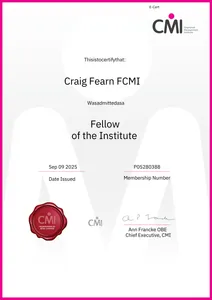
FCMI
Fellow, Chartered Management Institute
Read the certificate (PDF) -
IoD
Wellbeing Ambassador, 2021 to 2026
Lighthouse Mentoring is run by Craig Fearn, who works with individual chief executives separately and under his own name. This is the organisational side of that work.
05 — Writing
On governance, risk and the evidence.
-

When You Need a Stress Risk Assessment
Running wellbeing programmes without knowing whether they work is the common case. When an assessment is the right answer, and what one involves.
-

Wellbeing Governance: Why Boards Need a Strategy
Wellbeing has left HR's remit and become a governance question with consequences for risk, performance and resilience. Why it cannot be delegated.
-

Mental Health Governance: Board Responsibilities
Mental health is a board matter, not an HR one: legal duties, material risk and strategic exposure. What oversight looks like in practice.
Start with the question you actually have.
Whether that is what the duty requires, what an assessment would involve, or whether you need one at all. The first conversation costs nothing and does not end in a proposal you did not ask for.
Start a conversation